April 6, 2007 - Good Friday
Photos from this day are included in the REGENSBURG PHOTO SET and the PRAGUE PHOTO SET. (Prague is still being sorted and labeled.)
Regensburg – My sleep was disturbed with visions from Dom St. Peter, the Gothic cathedral. Medieval spirits, it seems. From our room we could hear talking, arguments, walking, laughing and singing from the cobblestone street below. Once I got up to look down only to see a shadow, quickly scurrying away.
Friday morning promised to be yet another glorious day. Good Friday is a holiday here, so none of the shops were open and the streets were empty. Around Dom St. Peter several young priests (or seminarians) were excitedly fluttering in their long black robes. They all looked very young to me, not more than 19 or 20 years old. They were practicing for the Good Friday service that would be held later in Dom St. Peter. (John remarked that he "feels sorry for them" - whatever that means!).
The cathedral is also home to the “Regensburger Domspatzen” (Boys choir), who sing here on Sundays and holidays when they are not traveling the world. It would be nice to hear them, but evidently the seats are booked well in advance of their performances.
Before we leave Regensburg, we make one last visit inside the cathedral. I am determined to make peace with the Gothic structure that has imposed its all-encompassing world view upon my psyche, both conscious and unconscious.
The Iron Curtain
We head east, toward the Czechoslovakian border and Prague. The German countryside was rolling, with forests and a windmill here and there. I didn't see any windmills in the Czech Republic.
We expected to be questioned at the border so I had our passports and car information ready. After all, this used to be called “the Iron Curtain”, and when I had traveled through Yugoslavia and Hungary in 1972 it was a big deal. Surprisingly the young border patrol authorities simply waved us through. They seemed somewhat bored and lackadaisical. This free passage from one country to another is supposedly the result of the formation of the European Union. It makes the border between the US and Canada look like an Iron Curtain by comparison!
As we travel through the western Czech Republic the land becomes more hilly and reminds me of a cross between KY and the steel mill towns of Pennsylvania. There are a lot of trucks on the road. My eyes begin to burn from the diesel fuel of all the trucks.
Czechoslovakia looks and feels very different from Germany, somewhat less tidy. The villages are much larger; there are more apparent factories and industry. And there are billboards, many in English. We see advertisements for Kentucky Fried Chicken and McDonald’s. There is a haze in the air.
I see a pile of junked cars with smoke/fumes rising from them.
Prague – Mala Strana
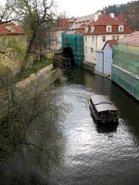
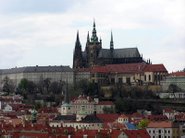
We get lost on our way into Prague. It is a very large, old, and sprawling kind of place. Finally, seeing the Vltava River and using it is our navigational guide, we make our way to the Mala Strana (Lesser Town or Little Quarter) of Old Prague - the part of town under the Prague Castle. I’m glad that I didn’t make reservations at one of the lesser expensive hotels in the outer lying area of Prague. Making the trip into town, even using the public transportation, would have been a hassle.
We found our hotel (the Hotel Roma) and stowed our car safely in the underground parking lot. Hartwig and Margret had warned us about “Russian owned” places, which this feels to be, but it is also quiet, comfortable and safe – and we can walk every where we want to go. Our room is on the 3rd floor, and we all like it. Eric says that it reminds him of the place where Ann Frank lived. I don’t think that Ann would have survived as long in Prague as she did in Amsterdam.
[For many centuries Prague was the most important Jewish center in Europe. The Jewish people built their community on the bank of the Vltava River, near the Old Town Square. In continual tension with Christian rulers, their movements were limited, they were identified as a minority group and they were alternately persecuted and expelled, or tolerated. Jewish refugees expelled from other countries came to Prague and for periods of time their culture flourished. In the early 18th century, more Jews lived in Prague than anywhere else in the world. At the start of World War II, 55000 Jews – 20% of the city’s population – lived in Prague. At least 2/3 of the Jewish population of Prague perished in the Holocaust. Today, about 1700 people living in Prague are associated with the Jewish community. (See here for more history of the Jews in Prague.)]
The Charles Bridge
Setting out to explore, we first wander down to the Charles Bridge. The crowd is thick and the energy of so many people sets the tone. This city is very different from Regensburg, even though the histories of both cities extend back to before Roman times. The buildings are very large here, old and of so many different styles it feels a bit “confusing”. John and I both say that it feels like a place where we’ve never been before, perhaps a bit like I would expect Moscow (or Russia).
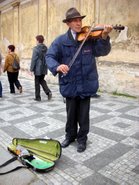
This is “middle Europe”, and evokes images from Tolkien’s Lord of the Rings books. Gypsies, street musicians. Hartwig says that Europeans are all descended (with much inter-mixing) from 3 ancient tribes: the Germanic, the Roman, and the Slavic. We are in Slavic land. Czechoslovakia is also referred to as “Bohemia”. Ancient Bohemia (before Roman times) was occupied by a Celtic tribe of people.
However, at this point I find myself wondering if the crowds around me are not all tourists from somewhere else.
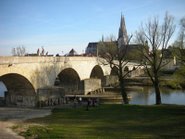
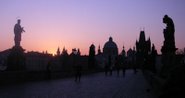
We venture onto the Charles Bridge from the Mala Strana side of the Vltava River. This bridge was patterned on the Old Stone Bridge in Regensburg with 16 arches, and was originally called the Stone Bridge of Prague. Along with the artists, performers, musicians and vendors, there are 30 large statues standing at guard.
The day before we left, one of my computer students who is Jewish told me to look for the “Hebrew Crucifixion” statue. The writings on the cross are all in Hebrew – “Jesus, King of the Jews”. When I see it, there are 2 policemen standing in front of it. Perhaps because it is Good Friday? The policemen were not there the next day.
When we reach the other side of the bridge – the Old Town – there is a dark Gothic tower that we climb and from which we can see the entire bridge and surrounding area. The tower was part of the old fortification system of Prague. The official name for this tower is: 'Staromestska mostecka vez'. We watch a little film there about the history of the bridge, Prague, and King Charles IV.
Charles IV (Karel IV) was king of Bohemia from 1346 to 1378 and Holy Roman emperor from 1355 to 1378. He was educated (he spoke 5 languages), a diplomat, and a good king. Charles established Prague as the cultural capital of central Europe and made it one of the most prosperous European cities at the time. Charles IV loved Prague and the city flourished during his rule.
According to the film, Charles secured his power and military strength by a strange merging of pagan sun worship with Christian martyrdom. On the summer solstice the sun sets on the Prague castle exactly where he has buried the bones of St. Vitus (vitus means “victory”). The relics of St. Vitus are supposed to have healing properties, and Charles gathered all of the known relics of Vitus to bury in the Prague cathedral.
Photos from this day are included in the REGENSBURG PHOTO SET and the PRAGUE PHOTO SET. (Prague is still being sorted and labeled.)
Regensburg – My sleep was disturbed with visions from Dom St. Peter, the Gothic cathedral. Medieval spirits, it seems. From our room we could hear talking, arguments, walking, laughing and singing from the cobblestone street below. Once I got up to look down only to see a shadow, quickly scurrying away.
Friday morning promised to be yet another glorious day. Good Friday is a holiday here, so none of the shops were open and the streets were empty. Around Dom St. Peter several young priests (or seminarians) were excitedly fluttering in their long black robes. They all looked very young to me, not more than 19 or 20 years old. They were practicing for the Good Friday service that would be held later in Dom St. Peter. (John remarked that he "feels sorry for them" - whatever that means!).
The cathedral is also home to the “Regensburger Domspatzen” (Boys choir), who sing here on Sundays and holidays when they are not traveling the world. It would be nice to hear them, but evidently the seats are booked well in advance of their performances.
Before we leave Regensburg, we make one last visit inside the cathedral. I am determined to make peace with the Gothic structure that has imposed its all-encompassing world view upon my psyche, both conscious and unconscious.
The Iron Curtain
We head east, toward the Czechoslovakian border and Prague. The German countryside was rolling, with forests and a windmill here and there. I didn't see any windmills in the Czech Republic.
We expected to be questioned at the border so I had our passports and car information ready. After all, this used to be called “the Iron Curtain”, and when I had traveled through Yugoslavia and Hungary in 1972 it was a big deal. Surprisingly the young border patrol authorities simply waved us through. They seemed somewhat bored and lackadaisical. This free passage from one country to another is supposedly the result of the formation of the European Union. It makes the border between the US and Canada look like an Iron Curtain by comparison!
As we travel through the western Czech Republic the land becomes more hilly and reminds me of a cross between KY and the steel mill towns of Pennsylvania. There are a lot of trucks on the road. My eyes begin to burn from the diesel fuel of all the trucks.
Czechoslovakia looks and feels very different from Germany, somewhat less tidy. The villages are much larger; there are more apparent factories and industry. And there are billboards, many in English. We see advertisements for Kentucky Fried Chicken and McDonald’s. There is a haze in the air.
I see a pile of junked cars with smoke/fumes rising from them.
Prague – Mala Strana
We get lost on our way into Prague. It is a very large, old, and sprawling kind of place. Finally, seeing the Vltava River and using it is our navigational guide, we make our way to the Mala Strana (Lesser Town or Little Quarter) of Old Prague - the part of town under the Prague Castle. I’m glad that I didn’t make reservations at one of the lesser expensive hotels in the outer lying area of Prague. Making the trip into town, even using the public transportation, would have been a hassle.
We found our hotel (the Hotel Roma) and stowed our car safely in the underground parking lot. Hartwig and Margret had warned us about “Russian owned” places, which this feels to be, but it is also quiet, comfortable and safe – and we can walk every where we want to go. Our room is on the 3rd floor, and we all like it. Eric says that it reminds him of the place where Ann Frank lived. I don’t think that Ann would have survived as long in Prague as she did in Amsterdam.
[For many centuries Prague was the most important Jewish center in Europe. The Jewish people built their community on the bank of the Vltava River, near the Old Town Square. In continual tension with Christian rulers, their movements were limited, they were identified as a minority group and they were alternately persecuted and expelled, or tolerated. Jewish refugees expelled from other countries came to Prague and for periods of time their culture flourished. In the early 18th century, more Jews lived in Prague than anywhere else in the world. At the start of World War II, 55000 Jews – 20% of the city’s population – lived in Prague. At least 2/3 of the Jewish population of Prague perished in the Holocaust. Today, about 1700 people living in Prague are associated with the Jewish community. (See here for more history of the Jews in Prague.)]
The Charles Bridge
Setting out to explore, we first wander down to the Charles Bridge. The crowd is thick and the energy of so many people sets the tone. This city is very different from Regensburg, even though the histories of both cities extend back to before Roman times. The buildings are very large here, old and of so many different styles it feels a bit “confusing”. John and I both say that it feels like a place where we’ve never been before, perhaps a bit like I would expect Moscow (or Russia).
This is “middle Europe”, and evokes images from Tolkien’s Lord of the Rings books. Gypsies, street musicians. Hartwig says that Europeans are all descended (with much inter-mixing) from 3 ancient tribes: the Germanic, the Roman, and the Slavic. We are in Slavic land. Czechoslovakia is also referred to as “Bohemia”. Ancient Bohemia (before Roman times) was occupied by a Celtic tribe of people.
However, at this point I find myself wondering if the crowds around me are not all tourists from somewhere else.
We venture onto the Charles Bridge from the Mala Strana side of the Vltava River. This bridge was patterned on the Old Stone Bridge in Regensburg with 16 arches, and was originally called the Stone Bridge of Prague. Along with the artists, performers, musicians and vendors, there are 30 large statues standing at guard.
The day before we left, one of my computer students who is Jewish told me to look for the “Hebrew Crucifixion” statue. The writings on the cross are all in Hebrew – “Jesus, King of the Jews”. When I see it, there are 2 policemen standing in front of it. Perhaps because it is Good Friday? The policemen were not there the next day.
When we reach the other side of the bridge – the Old Town – there is a dark Gothic tower that we climb and from which we can see the entire bridge and surrounding area. The tower was part of the old fortification system of Prague. The official name for this tower is: 'Staromestska mostecka vez'. We watch a little film there about the history of the bridge, Prague, and King Charles IV.
Charles IV (Karel IV) was king of Bohemia from 1346 to 1378 and Holy Roman emperor from 1355 to 1378. He was educated (he spoke 5 languages), a diplomat, and a good king. Charles established Prague as the cultural capital of central Europe and made it one of the most prosperous European cities at the time. Charles IV loved Prague and the city flourished during his rule.
According to the film, Charles secured his power and military strength by a strange merging of pagan sun worship with Christian martyrdom. On the summer solstice the sun sets on the Prague castle exactly where he has buried the bones of St. Vitus (vitus means “victory”). The relics of St. Vitus are supposed to have healing properties, and Charles gathered all of the known relics of Vitus to bury in the Prague cathedral.
Eric surmises that religion was used as a ploy to keep the people fighting for the king. I wonder if things are much different now.
We then just wander around the Old Town and over to the Jewish ghetto area, known as Josefov, before crossing the bridge back to Mala Strana, a Czech dinner, and bed.
Photos from this day are included in the REGENSBURG PHOTO SET and the PRAGUE PHOTO SET. (Prague is still being sorted and labeled.)
We then just wander around the Old Town and over to the Jewish ghetto area, known as Josefov, before crossing the bridge back to Mala Strana, a Czech dinner, and bed.
Photos from this day are included in the REGENSBURG PHOTO SET and the PRAGUE PHOTO SET. (Prague is still being sorted and labeled.)