Showing posts with label Czech Republic. Show all posts

Sunday, April 8, 2007

Prague, the Autobahn, and Easter at Axel's - April 8th


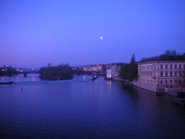
Moon over Vltava River, Prague, Easter Morning

Easter Sunday, April 8, 2007

[Photos from this day are included in the Prague photo set, the Photos from the Road set, and the Easter at Axels’s set.]

Sunrise in Prague

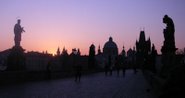
I awakened early on Easter morning, and was unable to go back to sleep so around 5 AM I ventured out into the pre-dawn streets of Prague. It was freezing cold. Down at the Charles Bridge the photographers were setting up for what promised to be a stunning sunrise. The sky was perfectly clear. There was a cluster of people smoking marijuana, and 2 drunk (or very high) girls huddled and babbling loudly from the foot of one of the statues. Occasionally someone crossed the bridge who looked like they were going to work.

I watched the sky. I was not pleased with any of my photos facing the sunrise from the bridge. It was when I turned away from the “spectacle” and looked at something else that I captured something of the loveliness of the morning.

I expected to hear the bells of the many Churches as the day broke, but surprisingly I only remember one lone bell at around 6AM.

We were due back in Parsdorf for Easter dinner with the Voges family, so after breakfast we retrieved our car from the parking place under the hotel and took to the road again. This time we knew our way and didn’t have much trouble getting out of Prague, but we still hadn’t figured the one-way signs out and at one point we found ourselves on a narrowing street that was just for trolley cars. (John quickly backed out of that!)

The Autobahn

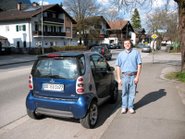
On this Easter morning, the Western Czechoslovakian landscape was glorious. I saw crumbling castles in the distance and the towns and villages looked pastoral. There were no trucks on the road, and we had no problems getting through the “iron curtain” back into Germany. I don’t know how John did it, but we were back in Parsdorf in about 3 hours. When there are no speed limits posted on the Autobahn, you can go as fast as you want – and John did. We needed to get gas on the way – more than $5 per gallon.

Easter dinner at Axel’s

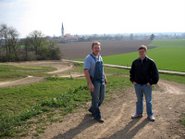
We went from the home of Hartwig and Margret to the home of one of their sons – Axel (Alexander) – about 10 km from Parsdorf (I don’t remember the name of the town). We have known these sons, Alexander and Andre, since 1980 when they were 9 and 10 years old. They are now grown up with wives and children and homes.

Axel’s home is considered to be “in the country”, but it is really on the road that connects the little villages. Land here is very expensive; I think 500 euros per square meter, or something like that, so owning a home with land around it is special. Axel and Martina have a small home that was built in 1920. They are both earthy and handy (and hard-working) and have made for themselves and their children a very unique and comfortable home.

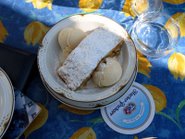
We felt very fortunate to be able to spend Easter with our German friends. We had “Easter Bread” with coffee when we arrived, and later a Bavarian (Schwalbian) meal of roast with onions, red cabbage, green beans and potatoes. Each time we blessed the food and each other by holding hands and chanting a German Kindergarten grace:

Piep piep piep
Wir haben uns alle lieb! (we all love each other)
Bon Apetit!
Our friends and their children and grandchildren made this a very special day for us.

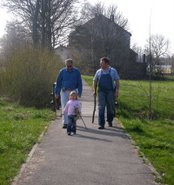
Margret is an exceptional and rare woman. She knows how to lose herself to the heart and mystery of what is good in life. When she is with her grandchildren she completely enters their world – verbally, physically and spiritually. Later that evening, as we were talking, she told me that she would not want to live in Munich or village much larger than Parsdorf (population about a thousand). They have lived in Parsdorf for 30 years and know everyone in the village. “We all know each other, raised our children together, and now we are growing old together”, she told me. “There is much comfort, security and mystery in that for me.”

[Photos from this day are included in the Prague photo set, the Photos from the Road set, and the Easter at Axels’s set.]

Saturday, April 7, 2007

Prague - Holy Saturday, April 7th

The Mala Strana (Lesser Town) and Prague Castle
photo taken from the Charles Bridge

April 7 – Holy Saturday

[Photos from this day are in the PRAGUE PHOTO SET.]

Knowing that our time in Prague was limited, we set out to explore and come to know Prague as we could in this one day. The day began overcast and a bit cold.

After a so-so breakfast (corner-cutting, with flavored sugar water for “juice” and coffee from a cheap cappuccino machine – at least they can’t screw up tea!) at the Hotel Roma, we headed back down to the Charles Bridge. There were things on the other side that we needed to see again before exploring our side (the Lesser Town, Mala Strana). I looked for the Czech-glass earring stand that I had seen on the bridge the day before, but he wasn’t there. Nor were the policemen at the Hebrew Crucifixion statue.

Prague has been a big deal, as a city, for a long time, its history tied to the land of Czechoslovakia / Bohemia. I knew that we would never be able to grasp more than a rudimentary understanding of all that had happened here. So we contented ourselves to see and experience what we could of Prague-2007.

Old Town Square
We wandered again through the Old Town section, making our way to the Old Town Square (Staromestske Namesti), Prague’s oldest marketplace. There were many souvenir shops – marionettes, nested egg dolls, painted eggs, Czech glass. I was in search of some Czech glass earrings. We saw a roasting pig (I think it was a pig).

Dominating one side of the Old Town Square is the huge Gothic cathedral, the Church of Our Lady Before Tyn, which was the main parish church of Old Town Prague. We had been calling this “the Darth Vadar Castle”, and I was somewhat surprised that it was a church since the spires are so much higher than the crucifix.

The astronomical clock at the Town Hall has dials that represent the positions of the Sun and Moon and stars, as well as figures and other moving statues that parade on the hour. The “Death” statue tolls the bell. The clock was made in 1410 and has worked continuously since then and still works (tell that to the computer makers!).

Josefov - the old Jewish ghetto
We meandered again over to Josefov, the old Jewish Quarters. For some reason, there were policemen around. We looked again at the Jewish museum (we didn’t go in), the Old Synagogue and the cemetery. There was one section of the cemetery that looked like it had been created over shops – or probably it is the other way around, the shops were built under the cemetery. I sensed a mysterious energy here in this old Jewish ghetto area.

Making our way back to the bridge via the river we passed the Rudolfinum Concert Hall. The presence of music is apparent everywhere in Prague, from the street musicians to the many posters advertising concerts.

The Mala Strana and Prague Castle
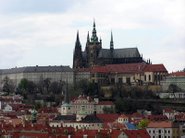
Again on the Mala Strana side of the River, it was time for us to climb the steps to the Prague Castle. The Castle is actually a whole complex of buildings – cathedrals, government office buildings, etc. It is old and impressive – gothic and baroque and other architectural styles - perhaps especially the St. Vitus Cathedral. We did not wait in lines for tours. Sometimes I think that I need days to just study one aspect of things, and I wonder if trying to take in Prague in one day is not merely skimming the surface of the city's complex life.

John was hungry about now, so we had a Czech lunch somewhere on the way down the steps from the Castle. I found myself wondering what kind of life had taken place through the centuries on these streets below the Castle.

Petrin Hill Park
By mid-afternoon the sky had cleared and the weather became delightfully sunny and warm. We spent the afternoon climbing and exploring Petrin Hill, which was just across the street from our hotel. A very pleasant park, dogs are (of course) allowed here, and there is even a point beyond which they do not need to be leashed. This pleased me immensely. It truly is a joy to see how much Europeans love their dogs. They are allowed in all restaurants, with waiters serving water to the dogs before their owners!

There is a memorial in the Park to those who died and suffered during the years when Czechoslovakia was under Communist rule. Great views of Prague and the Prague Castle from here. At the top there was an Observation Tower. Also a mirror-maze which we decided not to go into, but I’m still wondering what it was like.

The Church of the Infant of Prague
Walking back to our hotel we happened upon the Church of the Infant of Prague. As a child I had an “infant of Prague” doll and my father always said a little prayer to the Infant of Prague. John and Eric had never heard the story so we went into the Church and there was the original doll, amidst gold and splendor, on a side altar. It still feels a little hokey to me.

The restaurant where we wanted to have dinner was full so we went to a little cafĂ© across from our hotel that was run by 2 (or 3) very friendly and enterprising young Russian men. The food was quite good – a mix of Italian/Asian/American. All of the people there were young, like in their 30’s and American music played in the background.

epilogue - (notes before going to sleep)
There is a fair amount of graffiti in Prague, and I wonder what this is about. John says that it is “inexcusable”; it feels a bit angry to me – like the visible presence of some repressed part of the population. The parts of Prague that we visited were clean and interesting. But there is a washed-out feel, visually, to the city when I see it from a distance. It was like this in Rome – perhaps it is the oldness. I kept wondering if there was something wrong with my camera, or if the pollution had something to do with it. I’m not sure if the Prague that we are seeing has anything to do with Czechoslovakia as it is today. Most of the people we meet are from somewhere else. I met a delightful shopkeeper while I was looking for my Czech glass earrings (which I never got). She spoke good English and was very interested in me- Americans. She said that she was from The Ukraine. I don’t even know where The Ukraine is.

[Photos from this day are in the PRAGUE PHOTO SET.]

Friday, April 6, 2007

Regensburg, the Iron Curtain, and Prague - Good Friday, April 6th


April 6, 2007 - Good Friday

Photos from this day are included in the REGENSBURG PHOTO SET and the PRAGUE PHOTO SET. (Prague is still being sorted and labeled.)

Regensburg – My sleep was disturbed with visions from Dom St. Peter, the Gothic cathedral. Medieval spirits, it seems. From our room we could hear talking, arguments, walking, laughing and singing from the cobblestone street below. Once I got up to look down only to see a shadow, quickly scurrying away.

Friday morning promised to be yet another glorious day. Good Friday is a holiday here, so none of the shops were open and the streets were empty. Around Dom St. Peter several young priests (or seminarians) were excitedly fluttering in their long black robes. They all looked very young to me, not more than 19 or 20 years old. They were practicing for the Good Friday service that would be held later in Dom St. Peter. (John remarked that he "feels sorry for them" - whatever that means!).

The cathedral is also home to the “Regensburger Domspatzen” (Boys choir), who sing here on Sundays and holidays when they are not traveling the world. It would be nice to hear them, but evidently the seats are booked well in advance of their performances.

Before we leave Regensburg, we make one last visit inside the cathedral. I am determined to make peace with the Gothic structure that has imposed its all-encompassing world view upon my psyche, both conscious and unconscious.

The Iron Curtain

We head east, toward the Czechoslovakian border and Prague. The German countryside was rolling, with forests and a windmill here and there. I didn't see any windmills in the Czech Republic.

We expected to be questioned at the border so I had our passports and car information ready. After all, this used to be called “the Iron Curtain”, and when I had traveled through Yugoslavia and Hungary in 1972 it was a big deal. Surprisingly the young border patrol authorities simply waved us through. They seemed somewhat bored and lackadaisical. This free passage from one country to another is supposedly the result of the formation of the European Union. It makes the border between the US and Canada look like an Iron Curtain by comparison!

As we travel through the western Czech Republic the land becomes more hilly and reminds me of a cross between KY and the steel mill towns of Pennsylvania. There are a lot of trucks on the road. My eyes begin to burn from the diesel fuel of all the trucks.

Czechoslovakia looks and feels very different from Germany, somewhat less tidy. The villages are much larger; there are more apparent factories and industry. And there are billboards, many in English. We see advertisements for Kentucky Fried Chicken and McDonald’s. There is a haze in the air.

I see a pile of junked cars with smoke/fumes rising from them.

Prague – Mala Strana

We get lost on our way into Prague. It is a very large, old, and sprawling kind of place. Finally, seeing the Vltava River and using it is our navigational guide, we make our way to the Mala Strana (Lesser Town or Little Quarter) of Old Prague - the part of town under the Prague Castle. I’m glad that I didn’t make reservations at one of the lesser expensive hotels in the outer lying area of Prague. Making the trip into town, even using the public transportation, would have been a hassle.

We found our hotel (the Hotel Roma) and stowed our car safely in the underground parking lot. Hartwig and Margret had warned us about “Russian owned” places, which this feels to be, but it is also quiet, comfortable and safe – and we can walk every where we want to go. Our room is on the 3rd floor, and we all like it. Eric says that it reminds him of the place where Ann Frank lived. I don’t think that Ann would have survived as long in Prague as she did in Amsterdam.

[For many centuries Prague was the most important Jewish center in Europe. The Jewish people built their community on the bank of the Vltava River, near the Old Town Square. In continual tension with Christian rulers, their movements were limited, they were identified as a minority group and they were alternately persecuted and expelled, or tolerated. Jewish refugees expelled from other countries came to Prague and for periods of time their culture flourished. In the early 18th century, more Jews lived in Prague than anywhere else in the world. At the start of World War II, 55000 Jews – 20% of the city’s population – lived in Prague. At least 2/3 of the Jewish population of Prague perished in the Holocaust. Today, about 1700 people living in Prague are associated with the Jewish community. (See here for more history of the Jews in Prague.)]

The Charles Bridge

Setting out to explore, we first wander down to the Charles Bridge. The crowd is thick and the energy of so many people sets the tone. This city is very different from Regensburg, even though the histories of both cities extend back to before Roman times. The buildings are very large here, old and of so many different styles it feels a bit “confusing”. John and I both say that it feels like a place where we’ve never been before, perhaps a bit like I would expect Moscow (or Russia).

This is “middle Europe”, and evokes images from Tolkien’s Lord of the Rings books. Gypsies, street musicians. Hartwig says that Europeans are all descended (with much inter-mixing) from 3 ancient tribes: the Germanic, the Roman, and the Slavic. We are in Slavic land. Czechoslovakia is also referred to as “Bohemia”. Ancient Bohemia (before Roman times) was occupied by a Celtic tribe of people.

However, at this point I find myself wondering if the crowds around me are not all tourists from somewhere else.

We venture onto the Charles Bridge from the Mala Strana side of the Vltava River. This bridge was patterned on the Old Stone Bridge in Regensburg with 16 arches, and was originally called the Stone Bridge of Prague. Along with the artists, performers, musicians and vendors, there are 30 large statues standing at guard.

The day before we left, one of my computer students who is Jewish told me to look for the “Hebrew Crucifixion” statue. The writings on the cross are all in Hebrew – “Jesus, King of the Jews”. When I see it, there are 2 policemen standing in front of it. Perhaps because it is Good Friday? The policemen were not there the next day.

When we reach the other side of the bridge – the Old Town – there is a dark Gothic tower that we climb and from which we can see the entire bridge and surrounding area. The tower was part of the old fortification system of Prague. The official name for this tower is: 'Staromestska mostecka vez'. We watch a little film there about the history of the bridge, Prague, and King Charles IV.

Charles IV (Karel IV) was king of Bohemia from 1346 to 1378 and Holy Roman emperor from 1355 to 1378. He was educated (he spoke 5 languages), a diplomat, and a good king. Charles established Prague as the cultural capital of central Europe and made it one of the most prosperous European cities at the time. Charles IV loved Prague and the city flourished during his rule.

According to the film, Charles secured his power and military strength by a strange merging of pagan sun worship with Christian martyrdom. On the summer solstice the sun sets on the Prague castle exactly where he has buried the bones of St. Vitus (vitus means “victory”). The relics of St. Vitus are supposed to have healing properties, and Charles gathered all of the known relics of Vitus to bury in the Prague cathedral.
Eric surmises that religion was used as a ploy to keep the people fighting for the king. I wonder if things are much different now.

We then just wander around the Old Town and over to the Jewish ghetto area, known as Josefov, before crossing the bridge back to Mala Strana, a Czech dinner, and bed.

Photos from this day are included in the REGENSBURG PHOTO SET and the PRAGUE PHOTO SET. (Prague is still being sorted and labeled.)